Collateral Damage: Dani: Executive Order 14168
Editor's Note: This is the first of three article's in this series and are part of a larger effort to tell stories of Bucks County Residents who are impacted by the changes in our country. All politics is local. All politics is personal.
Sign up for our newsletter or social media to be alerted as each part is published.
As my husband David and I finalized the list of daytime stops and overnight accommodations for an ambitious plan to fly to the United Kingdom and make a nearly 600 mile road trip through Scotland, England, and Wales, I sent a snapshot of the mapped out route to our close friend, Dani.
Following the initial excitement of sharing our plans, the next question was one of invitation: we welcomed her to join us. Immediately after, I apologized, noting that we had contacted her directly – rather than using our group chat thread – out of concern her partner may find it upsetting.
“Aimee is absolutely invited,” I had hastily added. “I just didn't know how you approach it with them.”
Dani and her partner Aimee live in our neighborhood in Doylestown. Both work full-time, keep a warm and inviting home together, and spoil their cats spectacularly. Their interests align with ours in fortuitous ways, largely centered around similar enjoyment of foods, film and television, and entertainment ranging from theme parks to renaissance faires.
We have daytripped together by car; it felt natural to extend an invitation for our road trip.
The hesitance, however, centered on one specific aspect: we would need fly out of the United States.
It should not seem like a significant road block. Dani has traveled out of the United States last year and this year and has a passport. Aimee, who identifies as non-binary and uses they/them pronouns¹, did not go with Dani on those trips, despite having a passport.
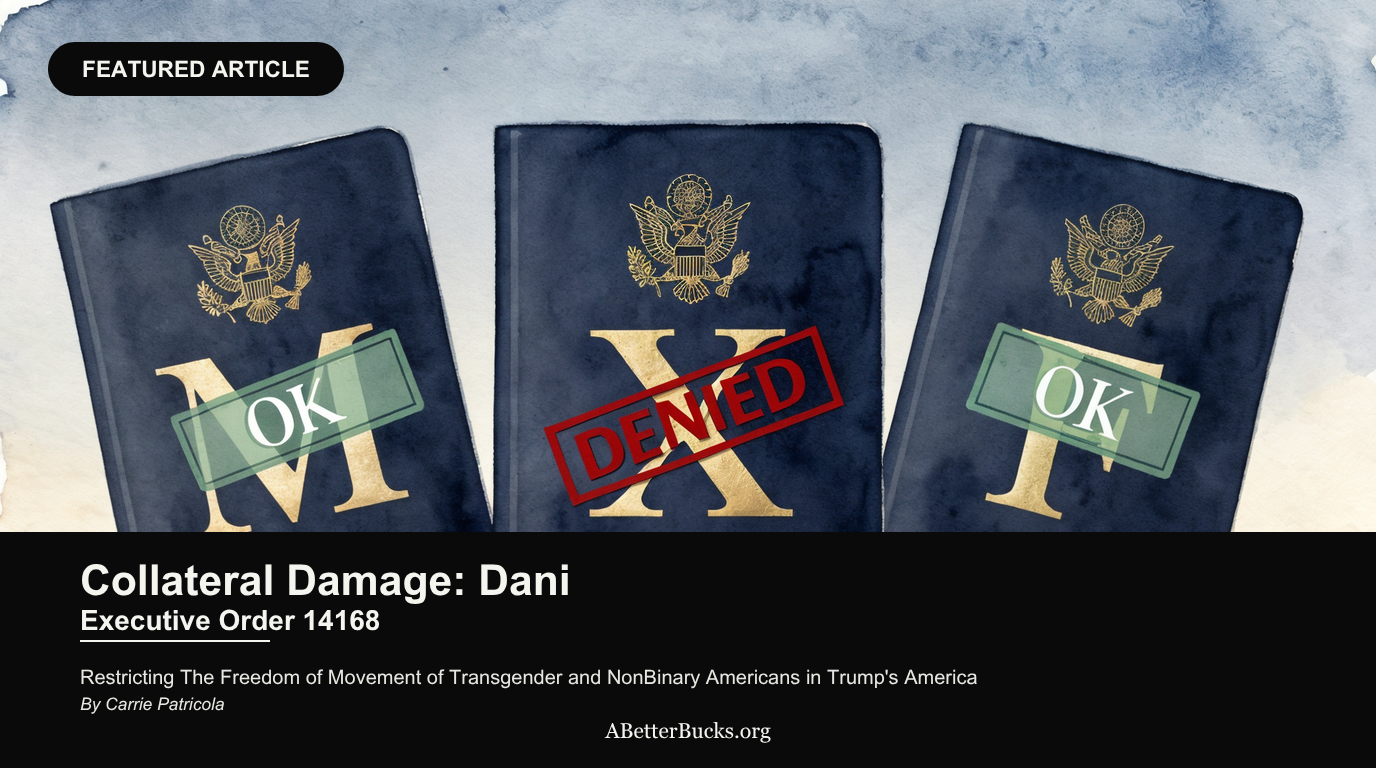
The problem is largely due to a single letter, the “X” marker on Aimee's passport, representing their gender identity. It also lists their name at birth. While Aimee had followed the legal processes to obtain an updated driver's license and birth certificate, once President Donald Trump signed Executive Order 14168 in January 2025, their progress was abruptly stalled.
The Executive Order, entitled “Defending Women From Gender Ideology Extremism And Restoring Biological Truth To The Federal Government”², lead to changes in passport policies and procedures that left Aimee in a precarious position.
Having now directly experienced the discomfort of wanting to invite both on our trip and knowing Aimee would have no choice but to decline, I sought to understand more about their situation and my own hesitation to make the invitation.
I sat down with Dani to understand: why did her partner of nearly five years years stay home while she traveled abroad? I asked her to unpack how Executive Order 14168 affected her life and their relationship since its announcement, in the present, and looking towards the future.
Starting with passport gender guidelines available at Travel.gov³, I asked Dani what those guidelines mean to her. As of August 16, 2026, the guidelines include the following statement:
Under the executive order, we no longer issue U.S. passports or Consular Reports of Birth Abroad with an X marker. We only issue a passport with an M or F sex marker that matches your biological sex at birth.
It further states:
All passports will remain valid until they expire, are replaced by the applicant, or until we invalidate them under federal regulations.
At the time of the Executive Order, Dani and Aimee had been together for over four years. Dani explained that the regulatory position on gender identity brought significant – and negative – impact.
“It's a lot. Basically, before that Executive Order came to place, Aimee had a passport with the X marker and their deadname⁴ on it.”
Dani adds, “it put them into a spot where they basically don't have a passport and can't get a new one. If they were to try to update it and submitted their current passport for the update, it would probably be confiscated because of the X marker. Also, [the government] probably wouldn't allow their current name on it anyways, so it basically just puts a ding on any potential plans we could have outside the country.”
At my request, Dani clarified, adding that Aimee's driver's license is valid and displays their chosen name, Aimee , with an X marker for gender. The update was made after Aimee obtained the appropriate court documents to change their legal name. Their passport, at the time of the Executive Order, had not yet been changed. It still displays Aimee's name given at birth (such as James or Michael).
The conflicting documents, combined with the impact on passport regulations, created significant worry, primarily around confiscation as a best case scenario, and at worst, a restriction against leaving and/or returning to the United States.
Under President Joe Biden, then-Secretary of State Antony Blinken released a press statement dated March 31, 2022, regarding gender identity markers on passports issued by the United States.⁵
I discussed this time period with Dani in the context of the press release, which included the following statement:
Starting on April 11, U.S. citizens will be able to select an X as their gender marker on their U.S. passport application, and the option will become available for other forms of documentation next year.
“When we first started our relationship, Aimee didn't have a passport at all,” Dani says. “Getting a passport was something that I brought up. I thought it was something good to have and would give us more flexibility with trips and stuff we can do together.”
The mood for Dani and Aimee was jovial during that time span. “It was very exciting for Aimee because it was super easy for them to get their passport,” Dani says, wistful. “There was no problem getting the X marker. For me, when they first got it, I almost felt relief because we both had the ability to travel out of the country.”
The change brought more than simple freedom to travel. Dani acknowledges the other useful purposes of a passport. “It's another identification document, another proof of citizenship. It's just a good thing for us both to have.”
It was a good feeling that did not last. Following Executive Order 14168 and its subsequent passport changes, Dani says the benefits of the document and any potential travel plans they had were abruptly “thrown out the window”.
Aimee, who has been working through a time-consuming multi-step process in updating their documents according to the laws, had completed a significant first step in obtaining a passport. Their next step was a legal name change; in the interim, the passport represented freedom of movement.
“We didn't travel,” Dani says, of the time immediately following Aimee's receipt of their passport. New plans were on the horizon. “They were focusing on other expenses, like their name change. It was kind of like – 'alright, great, we have the passport. Put it aside. Once everything else is out of the way, we can save towards traveling.'”
Due to President Trump's Executive Order, however, Dani recalls, “Traveling didn't happen.”
The ramifications were immediate and, in many ways, frightening.
“It created a roadblock where Aimee felt like they couldn't even leave the tri-state area for a while,” Dani recalls of the months that followed the January 2025 signing. “It wasn't just 'you can't get a new passport' or 'you can't get out of the country'. It was also, 'if you go to a different state, and someone sees you and doesn't agree with who you are, you can be arrested'. If someone checks their ID, they can get into trouble. I feel that, even though the Executive Order was just about gender identification on a passport, it came with a lot more strings attached than just leaving the country.”
Subsequent tension rippled beneath the surface of ordinary life for the couple.
“We started this when we were 26 years old,” Dani says. She and Aimee are a few weeks apart in age; they are now both 28 years old. Dani expresses grief for missed opportunities during what many would consider a prime part of their lifetimes, particularly for adults who have not yet started families.
“This is the time where you travel, that you go and see things,” she says. “For me, in the time span since that Executive Order, I've been to different states in the United States. I've been to Portugal, I've been to Greece. I just got back from Norway. I couldn't include my partner in any of it. Thankfully they – obviously – let me go, so that aspect isn't a problem.”
Regarding future plans, Dani notes, “I keep having to make plans that Aimee's not included in, and it's because of the Executive Order.”
I asked how discussion of travel plans unfolds between Dani and Aimee. “Leaving your partner for a week is never easy,” she says, “but it's the only option I have at the moment.”
Making plans has become something of a painful, delicate choreography. As someone who is open to new experiences and finds ease in making plans, coming up with ideas and successful financial planning is an easy task for Dani.
Each trip follows the same introductory pattern. When talking to Aimee, Dani usually opens the conversation with Aimee with a variation of I'm interested in doing this trip with my friends , followed by an affirmation that she feels shouldn't need to exist, but does. “I tell Aimee, 'I would invite you, too, but I can't at the moment'.”
“Before [Executive Order 14168], we could talk about bigger trips, plans to save up for it, go in a group where everyone brings their partner. There's no real point to any of that at the moment,” Dani says, acknowledging the thorny selfishness that comes with the next part. “It's still something that I want to do,” she explains of their current arrangement, “And Aimee understands.”
Dani internalizes the negative impact on her bond with Aimee that followed international trips taken without them. “I feel like it was more on my side. I was definitely sad. Especially [during the] first trip I took without them, I definitely missed them a lot.”
In the effort to remain resilient, she adds, “It took me a while to be able to be happy and have fun with it. It's kind of just something that we had to get used to. Neither one of us blames each other, but we're sad about it.”
For the future, both immediate and looking ahead into their 30s, Dani's tone takes on a grim hopelessness. “We honestly just have stopped talking about it,” she says, “because when we do, it's just the same conversation over and over again. There's nothing that we can do, and we don't know when it's gonna change. That whole aspect of our relationship has kind of just – dropped.”
To Dani, going on trips together is a significant part of a long-term relationship.
“I think it's a huge part,” she explains, “Because you're experiencing new things together. You're sightseeing, you're exploring, you're seeing maybe like different wonders or things that might be a once-in-a-lifetime experience for you, and that's probably something you want to experience with the person that you love the most.”
For Dani and Aimee, that segment of their life together is empty.
“There are a lot of people now out there that can't experience or achieve certain milestones that people would expect to have in one's lifetime. Especially now, being the summertime, most everyone anticipates people to go on a vacation. For us, if next step is marriage, to have a honeymoon.”
The impact felt for Dani and Aimee resonates in an often silent suffering across local and national communities. “People you know, people you see every day, they can be impacted by
this, and you won't even realize that they're not going to be able to experience those milestones right now, just because someone decided not to let them.”
As for the wider impacts beyond the borders, Dani sums up what Executive Order 14168 stripped away from her and Aimee. “It's a matter of feeling comfortable within our own country as well.”
Note: Names have been changed to protect the identity and safety of the individuals involved.
¹ https://www.minus18.org.au/articles/i-just-came-out-as-non-binary-here's-what-that-means/
² https://www.whitehouse.gov/presidential-actions/2025/01/defending-women-from-gender- ideology-extremism-and-restoring-biological-truth-to-the-federal-government/
³ https://travel.state.gov/en/passports/apply/unique-needs/sex-markers.html
⁴ A deadname , terminology common among transgender people, refers to the name they were given at birth. Shedding the name and adopting a chosen name, typically reflective of their gender identity, is a crucial part of gender affirmation. https://www.verywellmind.com/what-is-deadnaming-and-why-is-it-harmful-5188575
⁵ https://2021-2025.state.gov/x-gender-marker-available-on-u-s-passports-starting-april-11/

You must login to comment on this article.